LE MANS (1971): A Singular Racing Film and Cinematic Curiosity
LE MANS (1971) could almost serve as an unofficial sequel to Ford v Ferrari—if it weren’t burdened with so much behind-the-scenes baggage. If Grand Prix (1966) is motorsport’s Lawrence of Arabia, then Le Mans is Steve McQueen’s Fitzcarraldo—or perhaps road racing’s Apocalypse Now. Likely both.
This is an overblown epic, packed with artistic ambition and marred by a chaotic production. Like Apocalypse Now, Le Mans has since been recontextualized by an excellent making-of documentary, one that reveals the obsessive drive for realism that nearly destroyed the project. Unlike Coppola’s Vietnam masterpiece or Grand Prix, the other monumental motorsport epic of its time, Le Mans has long been viewed as a doomed vanity project. Yet buried within the chaos are moments of cinematic brilliance and genuine motorsport history.
Le Mans is such a unique film that it’s best appreciated on two distinct levels: as a visceral racing experience and as an experimental piece of cinema.
LE MANS (1971) AS A RACING EXPERIENCE
After a famously troubled production (detailed below), the film was eventually released in 1971, having been shot during the 1970 edition of the 24 Hours of Le Mans.
Without question, Le Mans is best viewed as a vivid, immersive record of the 1970 race—an iconic event in motorsport history. That year marked the beginning of Porsche’s dominance at Le Mans. Just one year earlier, in 1969, Ford had snatched victory from Porsche in one of the closest finishes ever, with its final GT40 run. With Ford stepping away in 1970, the top-tier Group 5 class became a head-to-head battle between Porsche and Ferrari teams. Porsche, determined to finally clinch a win, entered the race with unmatched intensity.
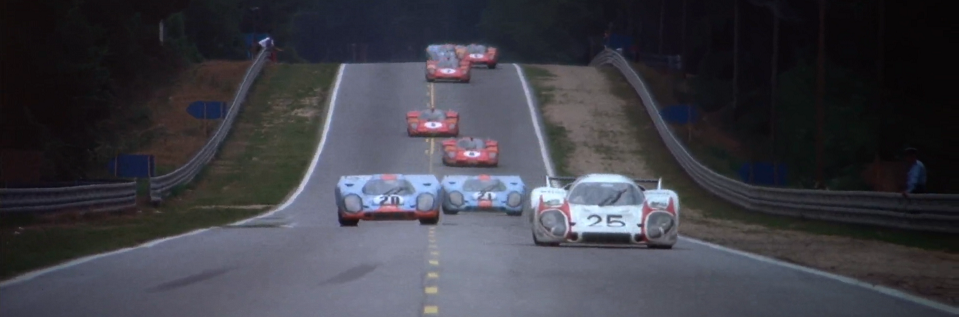
Heavy rain during the 1970 Le Mans reduced Ferrari’s power advantage and created far-from-ideal shooting conditions for the film. But the real stars of Le Mans aren’t the actors—they’re the machines, particularly the Porsche 917 Ks and Ls.
The short-tailed, blue-and-orange Gulf Porsches featured in the film are 917 Ks. The long-tailed white Porsche, which initially leads the race, is a 917 L from the Austrian factory team.
These Porsches competed head-to-head with the Ferrari 512 S, equipped with a 5.0L V12 engine producing 550 bhp. Like the Porsches, the Ferrari 512 S also came in a long-tail variant, specifically designed for improved high-speed aerodynamics on the long straights of Le Mans.
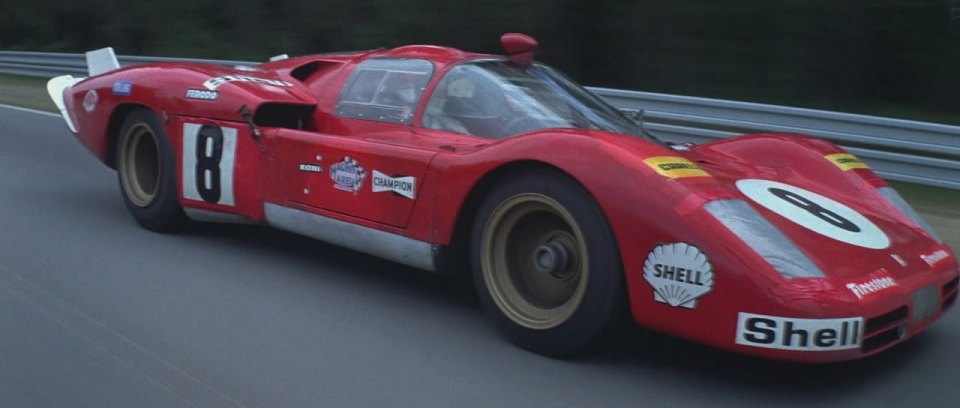
The only other Group 5 contender in the film is the Anglo-American Lola, which appeared barely competitive in this short-lived, high-horsepower era. (Though McQueen’s character does warn his teammate to “watch out for the red Lola” at the start.)
Le Mans captures a fleeting moment in motorsport history—an era that vanished almost as quickly as it arrived. The Group 5 cars of 1970 were so monstrously powerful that, by the time the film was released, the class had already been banned.
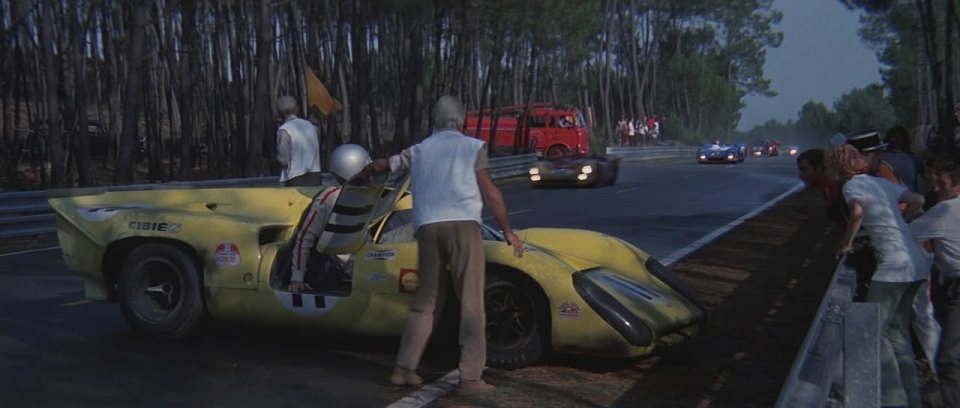
The Porsche 917s featured in Le Mans have since become iconic machines. However, viewers looking for background on the Gulf Porsche team won’t find much in the film itself.
Here’s some historical context, adapted from Wikipedia:
“After an inauspicious debut in 1969, extensive work was done by Porsche to fix the stability and reliability of the 917. After being beaten by a supposedly obsolete car…”
(That car was the Ford GT40, as dramatized in Ford v Ferrari.)
“…Porsche contracted John Wyer and his Gulf-J.W. Automotive Team to become the official works-supported team and development partner. During tests in Zeltweg, Wyer’s engineer, John Horsmann, had the idea to increase downforce at the expense of drag. He fashioned a new short tail by taping together sheets of aluminum. The result was a breakthrough: vastly improved stability. This version became the 917K (kurzheck, or ‘short tail’).
For Le Mans, an aerodynamic long-tail version—the 917L (langheck)—was developed with input from external consultant Robert Choulet. It featured an extended rear body and wing, designed for minimal drag. Dubbed “Batmobiles” by the media, these cars were visually and technically spectacular.
Two engines were used: a 4.5-liter flat-12 producing 550 bhp, and a newer 4.9-liter version with 590 bhp. Despite the speed advantage of the long-tail, most drivers preferred the 917K for its superior stability. The 917L, while faster on the straights, demanded significantly more concentration to control.”

The “short-tail” aerodynamic solution developed for the Porsche 917K will be familiar to viewers of the documentary Shelby American, as Carroll Shelby’s team arrived at similar conclusions around the same time.
Despite the prominence of the Gulf-liveried cars in Le Mans, the actual winner of the 1970 24 Hours of Le Mans was a Porsche 917K driven by Herrmann and Attwood, representing a Swiss works-supported team—not the Gulf team.
In what would become the first of many compromises, Steve McQueen was forced to abandon his dream of competing in the race while simultaneously making the film. His plan was to race alongside Jackie Stewart as co-driver. However, insurance concerns ultimately barred the world’s biggest movie star from taking part in one of the world’s most dangerous events—something that perhaps could have been anticipated had cooler heads prevailed. (Ironically, Stewart was also a notable absentee from Grand Prix.)
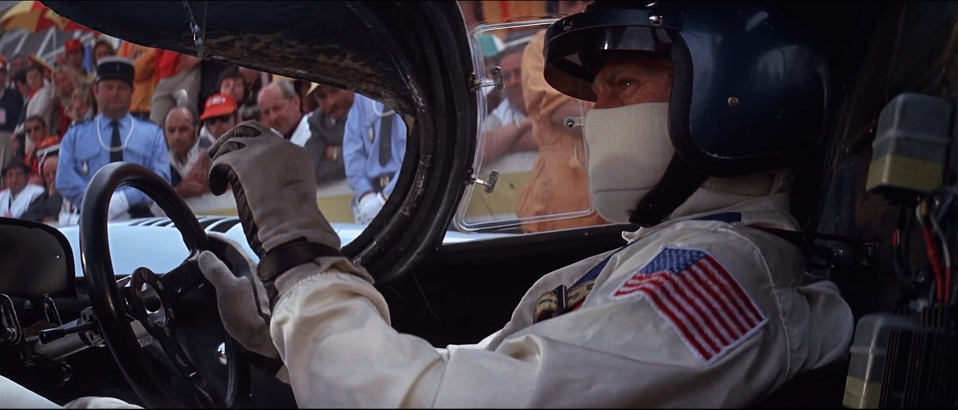
Rumors continue to circulate that McQueen drove the camera car during some of the stints. That car, impressively, finished the race—despite carrying the additional weight of camera gear. Even more remarkable: it was based on a “supposedly obsolete” chassis—the Ford GT40—and was the only GT40-derived machine on the grid.
The way the rain and grime interact with the cars and the circuit is both fascinating and oddly beautiful. There’s something fitting about the miserable weather of 1970—it strips away the glamour and replaces it with grit. At times, the film feels more like a French Woodstock documentary than a scripted racing drama. You can almost feel the heat and smell the oil, rubber, and wet tarmac.
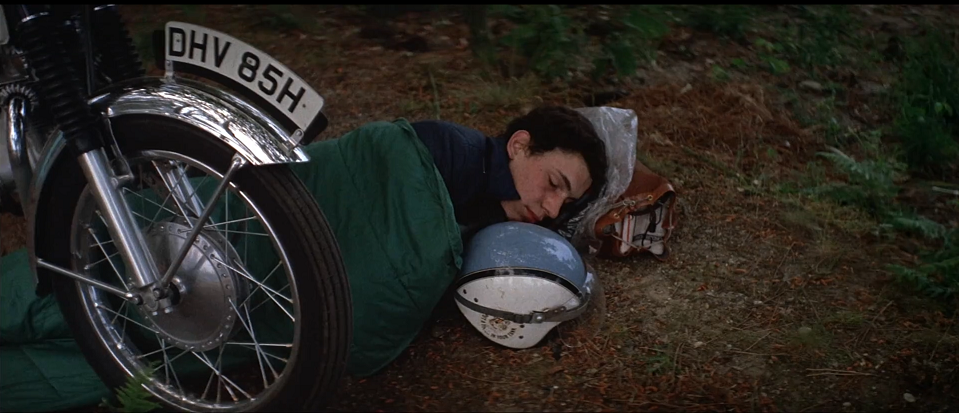
Flimsy fireproof suits and skinny helmets don’t look effective against mild flu germs let alone a 200mph crash on the Mulsanne straight in a 600hp car filled with 30 gallons of petrol. As described in the documentary, these soon to be banned Group 5 machines were ‘sharp knives’. The driver death wish of the time is of course the focus of GRAND PRIX, and LE MANS wisely chooses to mainly avoid that.
Compared with GRAND PRIX (1966)
The 1960s Hollywood race for “ultimate racing picture”, aka “DAY OF THE CHAMPION”, became eventually became Frankenheimers GRAND PRIX vs McQueen’s LE MANS. Somehow this schism echoes in Hollywood to this day, evidenced by the complete absence of any mention to F1 in Le Mans centered FORD vs FERRARI and SHELBY AMERICAN.
GRAND PRIX is period motor racing experience for the brain (and the nerves). LE MANS intends to be a far more emotional experience, the showing the gut sensations of being at the French event as a spectator and a driver. It tries to keep the detail sparse and it doesn’t make it easy for the casual viewer – for example, the the main rivalry confusingly is between an American driving a German car and a German driving an Italian car.

LE MANS is if anything too respectful, almost reverential. GRAND PRIX is sometimes contemptuous of the cult of death in the sport and the spectators. There is a common theme in both of drivers trying to deal with the widow of another driver. Both are more interested in driver deathwish psychodrama than the machinery, perhaps an inevitable consequence of the danger of the era
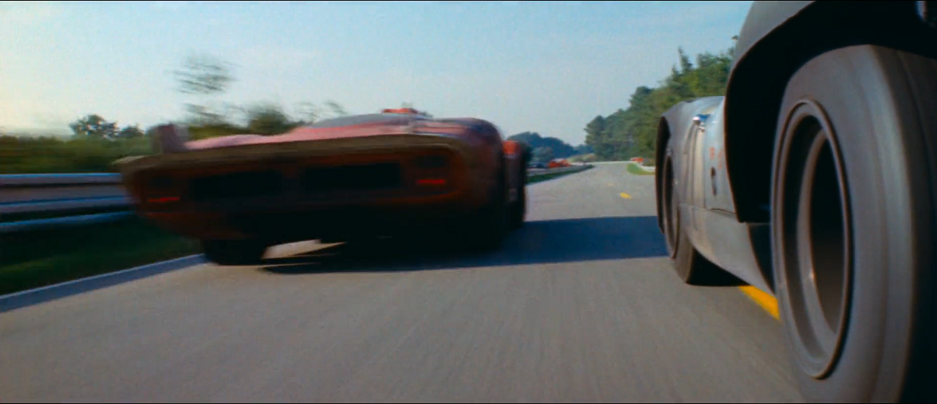
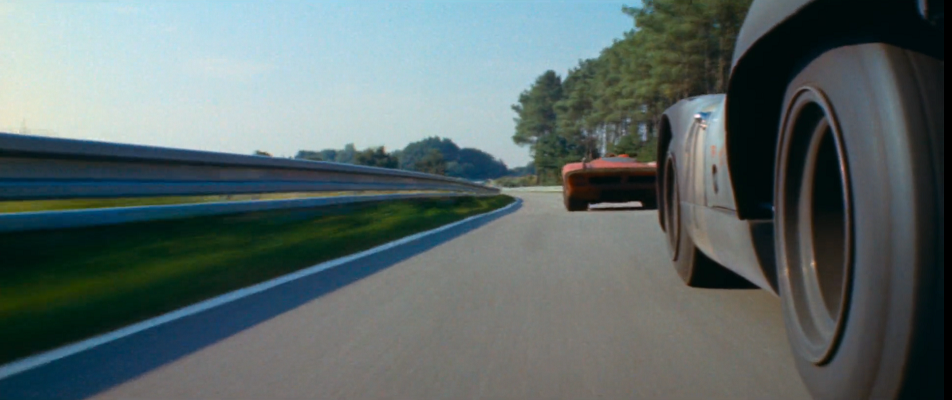
Again like GRAND PRIX the camera car footage is exceptional.
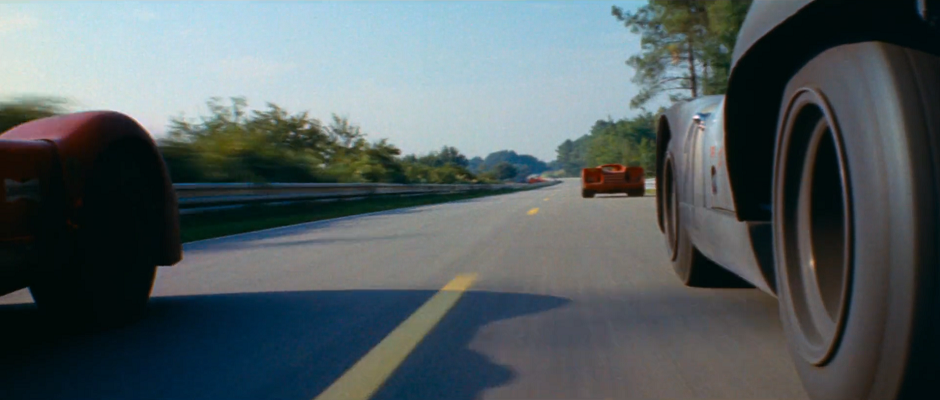
“I’ve never met a racing driver who could tell you WHY he races, but I could probably show you”
LE MANS (1971) AS A MOVIE
Le Mans (1971) isn’t just a sincere attempt to capture endurance racing on screen in all its grit and glory—it also stands as a cinematic mausoleum for one of the 20th century’s greatest movie stars. Steve McQueen, consumed by his passion for motorsport, drove his career—and arguably his personal life—into a wall trying to immortalize it on film.
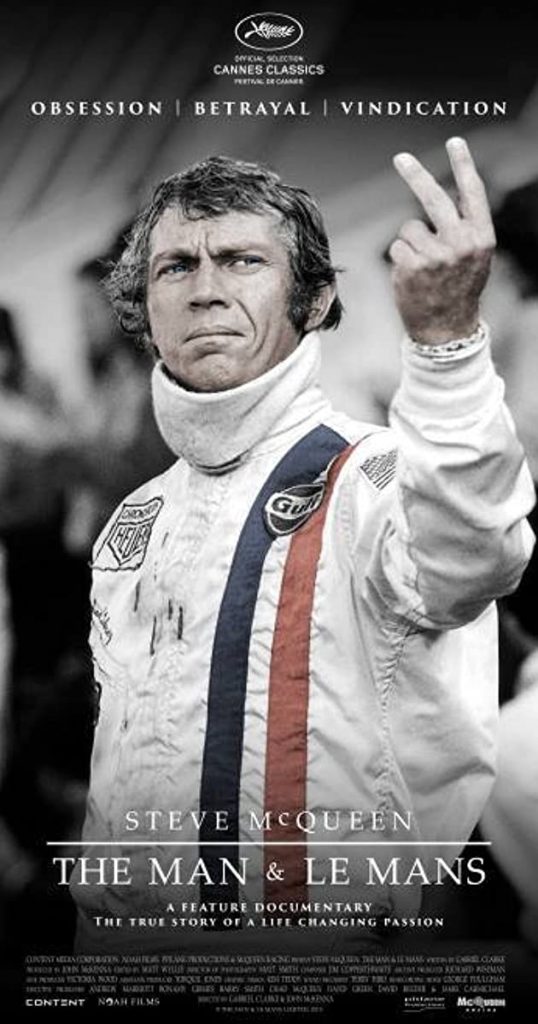
As detailed in the excellent documentary Steve McQueen: The Man & Le Mans, the 1960s cult icon allowed his racing obsession to take hold of him completely. Drawn into Hollywood’s unofficial race to make the definitive racing film, McQueen lost that battle to John Frankenheimer’s Grand Prix. Although he did manage to have a sequence from that film cut—thanks to an exclusive deal he secured with the Nürburgring—he was ultimately edged out of the Formula 1 narrative. With F1 no longer available, McQueen shifted his focus to the 24 Hours of Le Mans, perhaps spurred on by the historic 1966 event recently dramatized in Ford v Ferrari.
In a broader sense, Grand Prix and Le Mans can be seen as Hollywood’s direct responses to two landmark American achievements in international motorsport: Grand Prix followed Phil Hill’s 1961 Formula 1 World Championship win, while Le Mans came in the wake of Ford’s legendary victory at the 24 Hours in 1966.
The fundamental problem was that 24-hour endurance racing—featuring multiple teams, classes, and overlapping storylines—is even more difficult to distill into a coherent two-hour narrative than a Formula 1 race. McQueen, in his obsession with outdoing Grand Prix in terms of authenticity, likely saw that complexity as a virtue. But when your project loses one of the greatest action directors of the era, alarm bells should be ringing.
John Sturges—director of The Magnificent Seven, The Great Escape, Ice Station Zebra, and The Eagle Has Landed, among others—walked off the film due to creative clashes with McQueen. Reports suggest they disagreed over the film’s lack of romantic content. Possibly reflecting McQueen’s own personal turmoil—his marriage was disintegrating at the time—he pushed romance, a key component of commercial cinema in that era, to the margins. In doing so, he likely sacrificed one of the film’s greatest assets.
The making of Le Mans was so fraught with difficulty that, at one point, it tangentially overlaps with the tragic events referenced in Once Upon a Time in Hollywood. By sheer coincidence, the name “Sebring” frequently appears in this era—both as a venue for U.S. endurance racing and as the surname of one of the victims in the infamous Tate murders. A jaded and emotionally distant Steve McQueen even makes a brief appearance in Tarantino’s film, portrayed in a cameo by Damian Lewis.
When it comes to performances, Le Mans shows clear signs of strain—and it’s here that the absence of a strong director is most obvious. Even Grand Prix struggles at times with the same issue. There’s a strange psychological weight that seems to affect actors when dealing with a subject as starkly real as fatal motorsport.
On top of that, having a star as massive as McQueen so intimately involved in the production likely undermined the authority of his eventual stand-in director, Lee Katzin. Considering Katzin’s later résumé includes critically panned sequels to The Dirty Dozen, we might actually be fortunate the acting in Le Mans isn’t significantly worse.
Narration, Obsession, and the Madness Behind Le Mans
The circuit announcer’s commentary in Le Mans is grating—so much so that it brings to mind the infamous Harrison Ford voice-over in the original theatrical cut of Blade Runner. If anything, it’s worse: intrusive, monotonous, and likely unnecessary. It constantly states the obvious, breaking the immersion and undermining the film’s stark purity. One can’t help but wonder how much more absorbing the experience would be without it. Though Le Mans predates the modern concept of a “Director’s Cut,” it’s easy to imagine McQueen removing that narration in a re-release—stripping away distractions to let the film’s raw, visual storytelling speak for itself.
In at least one respect, Le Mans is comparable to Coppola’s Apocalypse Now. Coppola’s anti-war epic was infamously shot under chaotic conditions in the Philippines—an irony not lost on audiences, as the making of the film echoed the madness of the Vietnam War itself (a parallel explored in the essential Hearts of Darkness documentary).
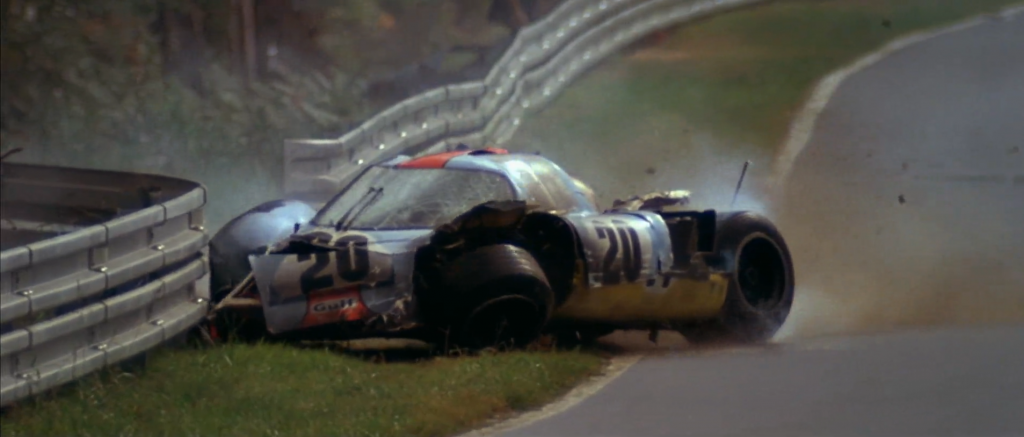
While Le Mans appears, on the surface, to be concerned with driver safety, the reality is far more troubling. During production, drivers Derek Bell and David Piper suffered near-fatal accidents—incidents that point to a deeper, dangerous obsession behind the camera. Like Apocalypse Now, Le Mans became a project so consumed by its pursuit of realism that it lost sight of its original purpose.
That said, the film does offer more than just stunning race footage.
A Cinematic Time Capsule with a Defiant Farewell
Le Mans is deeply rooted in a specific time and place. It may not be Grand Prix directed by Jean-Luc Godard, but it is arguably as French as any American film ever made. Like Frankenheimer’s Grand Prix, it wears its era proudly. At times, it even flirts with a kind of bohemian Easy Rider-esque psychedelia, helped along by the vivid colours and surreal atmosphere of the race itself. This aesthetic dated quickly—but now, viewed in high definition on a big screen, it becomes something else entirely: a dazzling time machine to the spectacle of motorsport half a century ago.
Michel Legrand’s beautifully atmospheric score for Le Mans remained unavailable for decades and only saw release with the accompanying documentary Steve McQueen: The Man & Le Mans last year. That delay is telling—it reflects how poorly the film was received by mainstream audiences at the time. It’s also another reminder of how vital the documentary is in recontextualizing the movie’s legacy (currently available on BBC iPlayer, reportedly).
The film’s final moment is perhaps its most memorable: Steve McQueen’s gesture of nonchalant defiance at the finish line. This is a race between an American and a German, driving for German and Italian teams, at the French Mecca of motor racing. Despite the many British drivers featured throughout—both as racers and as part of John Wyer’s Gulf Porsche team—no British characters appear in the film.
That British presence is acknowledged only in the final scene, and McQueen delivers it in a way that is both personal and symbolic. Rather than flipping the bird in the American style, he offers a two-fingered salute—the kind he likely saw used by the very British racers he idolised in the pits. After the downbeat yet meaningful conclusion of Ford v Ferrari, this sly sign-off feels perfectly in tune: a cheeky, irreverent nod to figures like Derek Bell, David Piper, and Ken Miles.
It is also, unmistakably, a calculated act of defiance—a final “screw you” to the studio executives and industry suits who tried to apply the brakes to one of the most ambitious (and chaotic) pieces of motorsport cinema ever made.